ROOFING
SERVICES
SELECT YOUR
ROOFING MATERIAL




Choosing a roof in Minnesota and Wisconsin
Almost every roof quoted in this region is architectural asphalt, and for a lot of houses that is the right answer. But the reason a homeowner ends up with asphalt is often that the contractor in the driveway only installs asphalt. Those are different things.
Here is what each material is actually for, and where it fails.
Asphalt shingles
The default, and a good one. Architectural laminate shingles are durable, well warranted, and inexpensive relative to everything else. Impact-rated Class 4 versions are available and worth asking about in a hail market. The limit is lifespan: asphalt loses granules, and granule loss is a clock.
Cedar shakes and shingles
Nothing else looks like it. Requires the right ventilation detail, the right fasteners, and periodic attention. It is also the material most often scoped wrong after hail, because damage on cedar does not look like damage on asphalt.
Natural slate
The roof that outlives the building. Most slate work here is repair and flashing renewal rather than replacement — the stone is usually fine and the nails are not. Heavy, so structure has to be confirmed first.
Clay and concrete tile
Extremely long-lived and Class A fire rated. The two questions are always weight and whether the profile can still be matched for repairs.
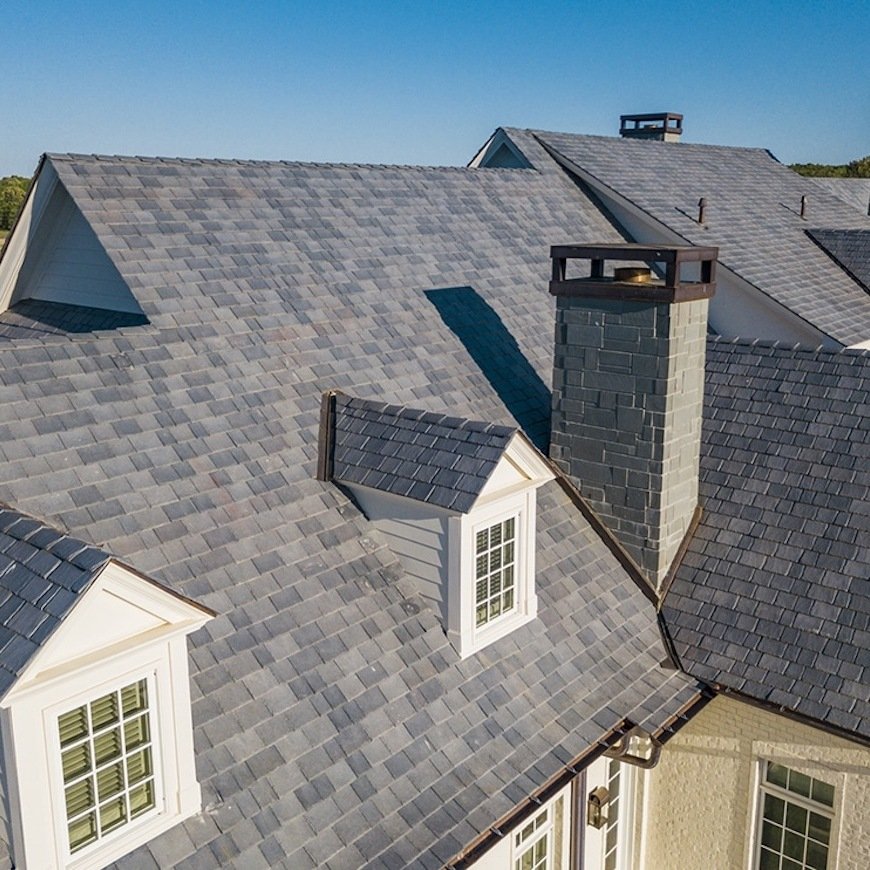
Composite slate and shake
DaVinci and Brava. The look of cedar, slate or barrel tile at roughly asphalt weight, with a Class 4 impact rating and a fifty-year or lifetime limited material warranty. In a hail market this is the material we push hardest, because it removes the failure mode.
Metal roofing
Standing seam sheds snow, has no exposed fasteners and lasts decades. It dents in large hail without failing, which makes the insurance conversation about cosmetics — check your policy language before you buy.
What separates a good roof from a cheap one
The shingle is the part you can see and the least important part of the quote. What actually determines whether a roof lasts is underneath it:
Ice barrier. Minnesota and Wisconsin both require ice-and-water protection from the eave to a point inside the exterior wall line. Coverage beyond the minimum in valleys and around penetrations is cheap insurance in this climate.
Ventilation. Intake at the soffit and exhaust at the ridge, balanced. Most premature roof failures here are attic moisture, not weather.
Deck condition. You cannot judge sheathing through shingles. Any quote written without a tear-off allowance is a quote with a change order built into it.
Flashing. New step and counter flashing, not reused. Reusing flashing is the single most common corner cut in this trade.
Who actually installs it. Manufacturer system warranties depend on certified installation. Ask which credential the company holds and whether it applies to your material.
Storm damage and insurance
Most roof replacements in this region are paid for by an insurance claim rather than out of pocket. That makes the claim process part of the job, and it is governed by different rules in each state. Wisconsin in particular restricts what a contractor may and may not do on your behalf.
Start here: roof insurance claims in Minnesota and Wisconsin · storm restoration · what a roof replacement actually costs.
Where we work
Twin Cities and Golden Valley, MN · Madison and Dane County, WI · Eau Claire, WI
Comparing contractors? We publish our own comparisons of the field: best roofing companies in the Twin Cities and best roofing companies in Madison and Dane County · best roofing companies in Eau Claire and the Chippewa Valley.
INSTALL THE BEST
WE PROUDLY


Lenz Construction is a CertainTeed ShingleMaster PREMIER contractor - CertainTeed’s highest roofing credential, and one of only two PREMIER contractors among the 49 credentialed residential roofers within 25 miles of our headquarters in Golden Valley, MN. That credential is what lets us write CertainTeed’s strongest system warranties on the roofs we install.


EXTERIOR INSPECTION, CONSULTATION, OR ESTIMATE
SCHEDULE AN
OUR OTHER
SERVICES
-
![Exterior porch with white siding, black shutters, wooden front door with glass panes, and decorative wall-mounted lantern lights.]()
SIDING
New siding is a great way to change the curb appeal of your home or give it a new look.
-
![An aerial view of a rural area showing trees down across a road, likely caused by a storm, with emergency responders and vehicles present at the scene.]()
STORM RESTORATION
We assess damage through inspections and prioritize repairs for your home.
-
![A room under renovation with a wooden ladder, paint supplies, and painter's drop cloths on the hardwood floor.]()
PAINTING
When it comes to painting we do it all from small painting projects to large commercial build outs.
-
![A person welding a metal piece, sparks flying in a workshop.]()
SHEET METAL
Custom sheet metal can elevate your home in aesthetics and efficiency.
-
![Bright living room with large windows showing autumn trees outside. Beige sofa with brown, red, and gray pillows, a wooden side table with a potted plant, a table with books, decor, and a lamp, and a framed picture on the wall.]()
WINDOWS
We work with major window manufacturers to produce beautiful, functional, energy efficient windows to your home or business.
-
![A house with a white gutter and downspout system, with the downspout curved and attached to the house's white siding, and the roof with black shingles. The house has a screened porch with white framing.]()
GUTTERS
From K style gutters to Custom Bent on site gutters we can do it all.
-
![Interior of a room under renovation with exposed wooden framing, insulation, and drywall damage. Construction tools, including a yellow hard hat and gloves, are on a ledge.]()
LEAD ABATEMENT
Ensure your home is safe and healthy by effectively addressing hazardous materials that may be out of date.
-
![Aerial view of a row of houses with gray shingled roofs, multiple chimneys, and surrounding trees.]()
COMMERCIAL
Collaborate with us on your next commercial project.